About Me
Twenty years of working inside complex organisations taught me one thing above everything else: the problem you can see is rarely the problem you need to solve.
I've spent two decades watching organisations try to fix execution problems with the wrong interventions. Not because the people involved weren't capable or the intentions weren't good, but because the solution was chosen before the problem was properly understood. A reorganisation that didn't change how decisions actually got made. A new system layered on top of a broken process. A transformation programme that addressed the symptoms while leaving the structural failures underneath them intact.
That pattern is what my practice is built to interrupt.
How I think about the work
Operating models are systems. The failures that matter most rarely sit inside a single function. They sit at the seams: between functions that should be coordinating but aren't, between strategy and the execution infrastructure meant to deliver it, between how the organisation was designed to work and how it actually operates. Fixing one part without understanding its connections to the rest is how well-intentioned interventions create new problems while solving old ones.
This means I start every engagement with diagnosis. Before any design work begins, I need to understand which structural failures are present, how they connect to each other, and what the system is actually doing versus what it was designed to do. What gets built afterward is only as good as the understanding it's built on.
My experience
My approach was shaped by two decades designing and running execution infrastructure in some of the most complex operational environments in fintech and professional services.
At Mercer, across two tenures spanning more than a decade within a $4.5B enterprise, I held a series of increasingly senior roles covering commercial operations, contracting and negotiations, the design and operational leadership of the multinational client group ($800M+ portfolio across 40+ countries), and a CFO-sponsored revenue model transformation. At Visa, I led global product operations transformation across five regions and 200+ countries.
Why independent practice
Large firms bring scale and brand. What they don't always bring is the freedom to start with the diagnosis and go where it leads.
I work independently because it means the person doing the diagnostic is the same person doing the design and, if you choose, leading the transformation. The continuity is the point.

Beyond my CV
I didn't plan to become a consultant. I planned to become an astronaut.
Growing up in the 1980s and 1990s, shaped by the science fiction that filled television and movies at the time, space felt like the most interesting frontier imaginable. I studied Astronomy and Physics with Russian language at university, with NASA somewhere in the back of my mind as the destination.
What I discovered along the way was that what I was really drawn to was the underlying question that astronomy kept asking: why do systems behave the way they do, and what happens when they don't behave the way you expect?
That question turned out to be portable.
The path from astrophysics to consulting was neither straight nor planned. It took me through History, through a series of roles that didn't obviously connect at the time, and eventually into financial services and professional services, where I spent two decades inside organisations trying to understand exactly the same thing: why does this system produce these outcomes, and what would need to change for it to produce different ones?
The scale changed. The curiosity didn't.
I'm an American, but have lived in London for more than eight years, which suits me. It's a city that rewards the same instinct: look underneath the surface of how things work and you'll find something more interesting than what's visible from the outside.
Outside work I'm still drawn to the questions that got me started. Science fiction remains a constant, less for the technology than for the way the best of it uses imagined systems to ask real questions about how the world works and why. It turns out that's not so different from what I do for a living.
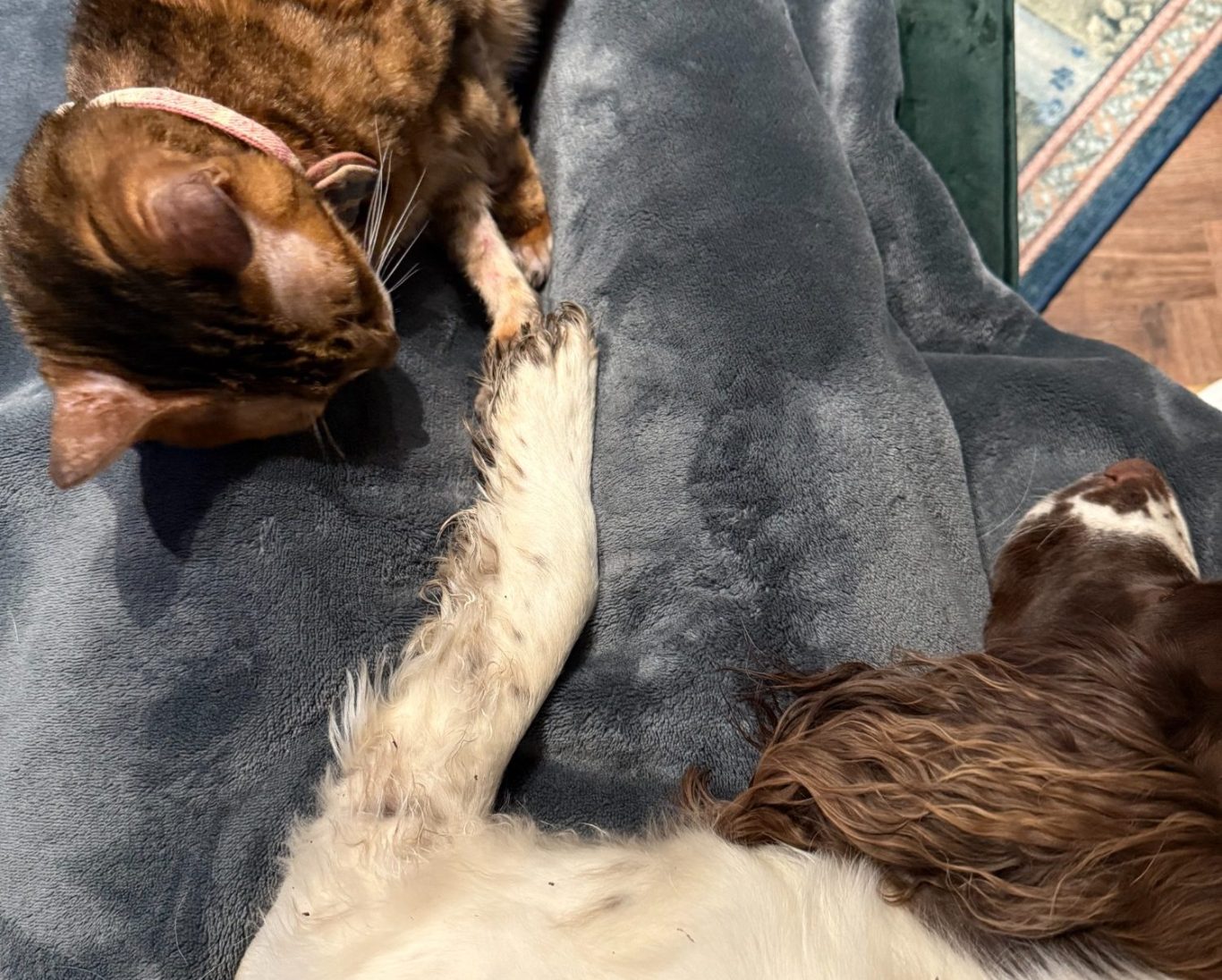
I share my home with Tilly, a dog of considerable personality and firm opinions about the daily schedule, and Mei Mei, a cat who maintains a more supervisory role in household operations. Between them, they provide a reliable counterpoint to any tendency to take the work too seriously.